
Mainframe Modernization
Move your mainframe application systems to modern Java without losing the business logic.
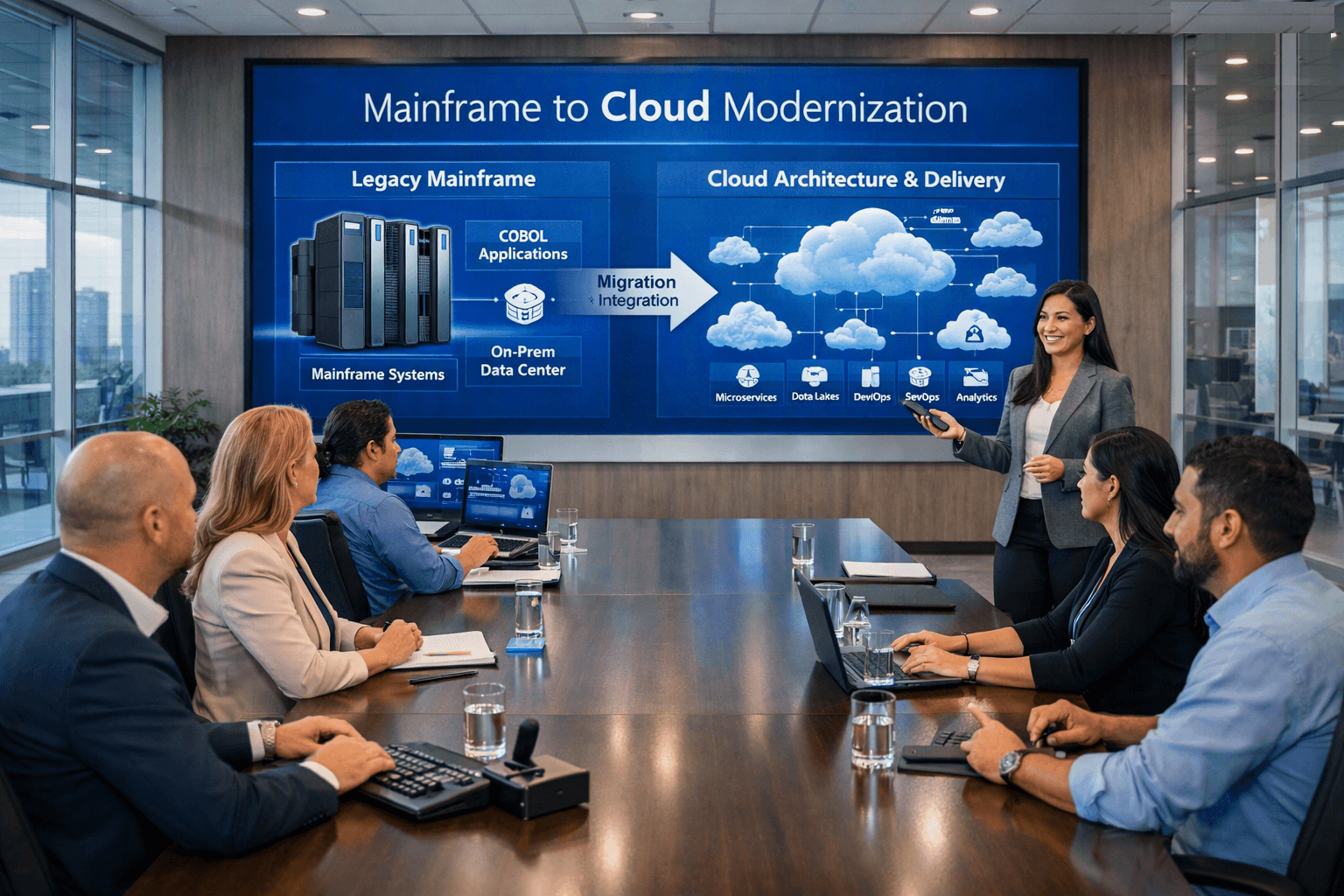
Your mainframe applications contain decades of proven business logic. The challenge isn’t what they do. It’s how difficult they’ve become to change, staff, and scale. DalTex Consulting modernizes legacy systems from the source code up, transforming them into clean, maintainable Java that your teams can own, extend, and deploy anywhere.
Shrinking talent pool
The challenge isn’t your mainframe logic, it’s the shrinking talent pool needed to keep it alive. As seasoned experts retire, organizations face rising costs, slower change cycles, and increasing operational risk.
Slow, costly change
Change moves slowly, costs keep rising, and legacy systems hold your business back. High annual licensing fees and lack of experts to run and maintain your toolsets.
Locked-in platforms
High MIPS costs and closed tooling make it difficult to integrate with cloud, APIs, and modern analytics. The result is a technology environment that limits innovation, restricts interoperability, and prevents organizations from adopting scalable, cost-efficient digital strategies.
Bottom-up modernization, starting at the source
Rather than rewriting from scratch (the slowest and riskiest path), we start with what already works: your source code and data model. Our automated conversion engine reads each program, transaction, screen and batch job, then generates equivalent, human-readable Java on a Spring Boot architecture. The result mirrors your original logic almost line by line, so your subject-matter experts can recognize it, verify it, and trust it.
- STEP 1
Discover and assess
Inventory COBOL programs, JCL job streams, CICS transactions, copybooks and screens. Map dependencies, scope and estimate.
- STEP 2
Extract the data model
Parse DB2 tables, keys, relationships and integrity rules. Generate DDL and documentation.
- STEP 3
Convert the code
Automatically generate readable Java that preserves business logic, comments and structure.
- STEP 4
Modernize the UI
Turn GUI windows and 3270 green screens into responsive web pages backed by REST services.
- STEP 5
Test and validate
Generated unit-test skeletons, parallel runs, and load testing with proven functional parity.
- STEP 6
Deploy and hand over
Release to cloud, on-premises or hybrid, and transfer full ownership of the source.
We map your entire mainframe estate before a single line is converted
Every engagement starts with a detailed assessment of your COBOL, JCL, CICS and DB2 assets. Online programs are only half the story: much of a mainframe’s critical work runs overnight in JCL job streams. We catalog how programs, jobs, transactions and data connect, so nothing is missed and your migration plan reflects how the system really runs.
Programs and copybooks
Program inventory, call trees, shared copybooks, complexity, and dead code.
Job streams and PROCs
Job steps, cataloged procedures, datasets, condition codes, restart points, and scheduler dependencies.
Online transactions
Transaction IDs, BMS maps, program links, and user-facing screen flows.
Data and SQL
Tables, keys, relationships, integrity rules, and every embedded SQL statement.
From mainframe components to a modern Java stack
Each legacy artifact has a clear, predictable destination. Online CICS and IMS transactions become REST APIs; business logic becomes plain Java objects; green screens become web pages; batch jobs become standalone Java programs. Because the new architecture keeps the shape of the original, operational teams adapt quickly, while developers gain the full flexibility of the Java ecosystem to include MVC, microservices, and SOA patterns.
A standard open architecture you fully own
Converted components deploy to any standard Java application server or container platform with a JDBC connection to your database: DB2 or another relational database of your choice. Each component remains an independent unit that can be packaged as a JAR, WAR or EAR and scaled across servers. The lightweight runtime library is open source and supplied with your code, so future development is never tied to us or to any proprietary vendor.
Code your developers will actually want to maintain
Automated conversion only pays off if the output is something manageable and functional. Our generated Java follows industry coding standards and object-oriented design. It stays faithful to the original design resulting in a smooth developer friendly translation.
Clean and faithful code
- Mirrors the original program flow almost line by line, so experts can verify it
- Original comments, spacing and structure are carried over
- Proper Java indentation, naming and object encapsulation
- Structured loops and conditionals, with no GO TO spaghetti
- Built-in functions and date arithmetic behave exactly as before
Data, testing, and operations
- JCL job streams converted to Java batch programs with the same step order, restart points, and dataset handling
- Complete DB2 data model extraction: keys, relationships, and integrity rules with DDL
- Efficient SQL with prepared statements and connection pooling
- Transactions commit and roll back at the same boundaries as today
- Generated JUnit test skeletons for automated regression and load testing
- Vendor and external program calls isolated in clearly marked extension points
Lower risk, faster results, full ownership
Less risk than a rewrite. Automated, rules-based conversion preserves the business logic your organization has refined for decades, rather than asking developers to rediscover it.
Faster time to value. Converting at the source level moves entire systems in months instead of years by migrating in phases with milestones, one application or component at a time.
No new lock-in. You receive all source code and an open-source runtime. Your application runs on standard Java with the platform of your choice.
Flexible engagement. Choose a fully managed migration by our team or a guided self-service model equipped and supported by DalTex Consulting with your own developers.
See what modernization looks like for your systems
Every mainframe portfolio is different. Tell us about your environment and we will walk you through a sample conversion, outline a phased roadmap, and provide a detailed estimate after an initial assessment.
- Side-by-side examples of legacy code and the generated Java
- A preliminary assessment of your COBOL, JCL, CICS and DB2 inventory
- A phased migration plan built around your business priorities
It’s DEMO Time!!!
Mainframe Legacy vs Modern JAVA Architecture
Once we receive access and authorization on your system, we shall create a working demo. We not only say we can modernize your legacy system, we prove it with a LIVE demo.
- A fully functional JAVA application operating in parallel with the existing mainframe application
- A batch procedure you identify
- A GUI window or 3270 green screen you identify